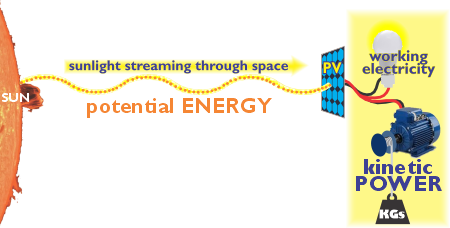
Here's an important distinction: because power is real time or kinetic it cannot be stored, but energy is potential and can be stored – electricity in a battery, or physical energy in a compressed spring. Since the two major sources of renewable (not fossil-fuel based) energy are intermittent – solar (PV) power only comes by day, and wind power is only available when it’s windy – storing electricity is important to providing the uninterrupted electricitry we take for granted. California is a world leader in stored electricity that replaces dirty fossil fueled peak demand generation. In 2026, California electric utilities had 13,800 MW of on-grid battery storage, and customers held another 2,200 MW – together, enough to power 15 million homes for one hour (or 1.5 million homes overnight.) That's about a tenth of California's residences, so we have a way to go to get clean!
| Here's another neat way to store electricity: 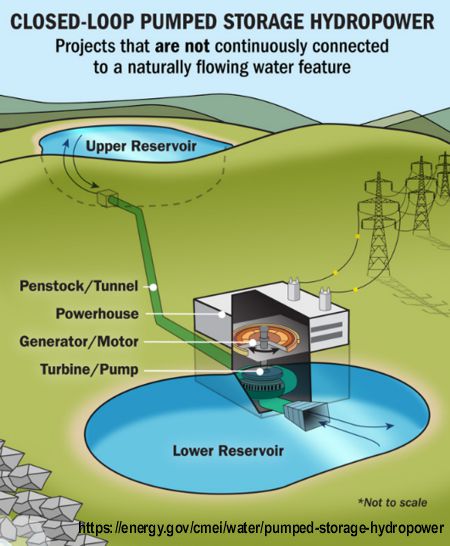 Pumped storage blends well with utilities that have excess power under some circumstances – more than enough PV harvesting on a sunny day – and can ‘time shift’ this surplus by using a generator ‘backwards’ to pump water uphill from a lower reservoir to an higher one. When power is needed back, water is released from the upper reservoir to turn the generators and send electricity to the grid. |
|
| |
 |
 |
| no nonsense privacy policy sitemap | |

| Nimda content administration system written by Michael Potts file updated 26 August 2026 copyright © 2003-2026 Caspar Institute |
| this site generated with 100% recycled electrons | |