
Science is the systematic study of the physical and natural world through observation and experiment. It is both a body of knowledge and the process used to discover how the universe works.
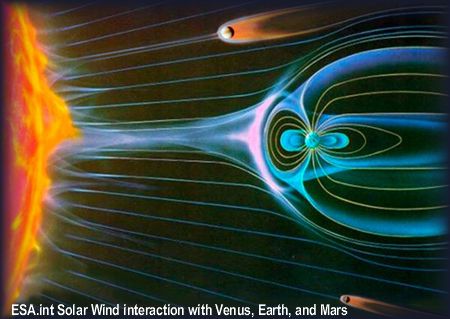 In this visual age, a good share of the scientific mission is explaining, clearly and memorably, what scientists are learning through images. Above, we see how Earth's strong magnetic field protects us from damaging radiation – protection that our planetary neighbors lack.
| 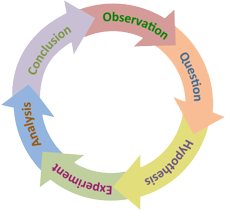 The scientific method is an empirical method for acquiring knowledge through careful observation, rigorous skepticism, hypothesis testing, and experimental validation. The scientific method is an empirical method for acquiring knowledge through careful observation, rigorous skepticism, hypothesis testing, and experimental validation.Science is the art of asking why? until adults get tired, poking things with a stick to see what happens, and making educated guesses before writing it all down in a very neat notebook.
~ Susan Lawler
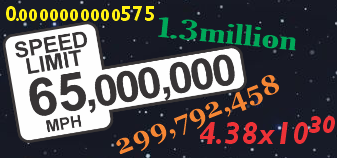 Lots of big numbers in science, because one of its primary functions is measuring and describing natural phenomena – measuring the enormous out from earth to sun and beyond, as well as the tiny: molecules and atoms. |
Seeing => TheorizingCareful observation, without expectation or desired conclusion, is the bedrock of science. Seeing what is really happening, and questioning why leads naturally to wondering about why: hypothesis, “a proposed, testable explanation for a phenomenon or a relationship between variables that serves as a starting point for further investigation.” Good, conscientious science (do you see the word science in the word conscientious?) carries on from forming an hypothesis to further testing, observation, and analysis – does the seeing conform to the hypothesis? Might there be a simpler explanation?
| RenderingAll the way from observation to conclusion, one of science's most powerful tools is imaging – sketches, diagrams, graphs, photos, computer-aided renderings – of what is seen. Often, as our tools have become more powerful, the resulting images are strikingly beautiful as well as powerfully instructive – as an example, the image (at the top of this page) of solar wind deflected from Earth by our planet's powerful magnetic field.
|
| Measurement - to come |
|
Temperature v. HeatWhen we say ‘it’s hot!’ we describe our experience of air molecules bouncing off our skin. That’s temperature: the average speed of the molecules in a material. In the US we use Fahrenheit degrees, an older scale where water freezes at 32° and boils at 212° (at sea level), and normal human body temperature is 98.6°. Scientists, thinking those numbers inconvenient, defined the Celsius scale, where water freezes at zero (0°C) and boils at 100°C. In the vacuum of space, there are no molecules, but there is plenty of heat: the visible surface of the sun, the photosphere, is 5,000°K -- degrees Kelvin.
Who’s Kelvin?
The Kelvin (°K) heat scale starts there, at the lowest measurable temperature, 0°K. The Kelvin scale is also used to measure the temperatures of very hot objects, like the surface of the Sun. | 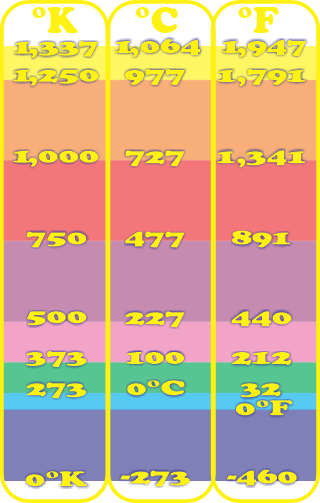 Temperatures are usually given in whatever unit is most familiar to the folks needing to know: jewelers like knowing that 24karat gold melts at 1,064°C or 1,974°F. In the US, we know our body temperature should hover around 98.6°F, but most places in the world, body temperature is 37°C.
Physicists have managed to freeze hydrogen at 0°K (the temperature at which all molecular motion stops.) Physicist and scientists often prefer the Kelvin scale.
To convert °F to °C, we use the formula
t(°C) = T(°F) - 32 x (100/180)
or
t(°C) = T(°F) - 32 x (5/9)
To get from °C to °F, we use the formula
t(°F) = (T(°C) x (9/5)) + 32
To get from °C to °K, add 273. |
|
| |
 |
 |
| no nonsense privacy policy sitemap | |

| Nimda content administration system written by Michael Potts file updated 16 September 2026 copyright © 2003-2026 Caspar Institute |
| this site generated with 100% recycled electrons | |


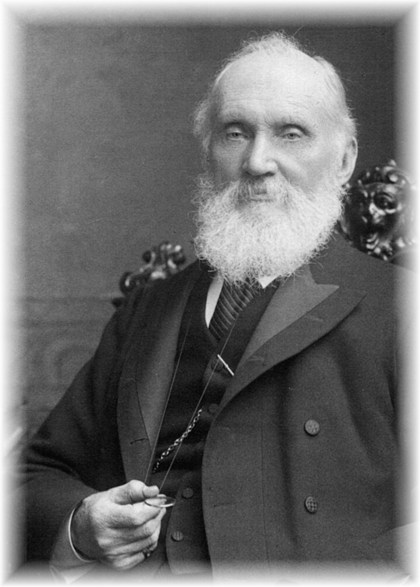 In 1848, William Thomson, who was later ennobled as Lord Kelvin, proposed the revolutionary theory that at a certain point, molecules completely stop moving, and that point was another logical reference point for measuring heat. Somewhat later, scientists confirmed his theory: all physical molecular motion stops at -273°C.